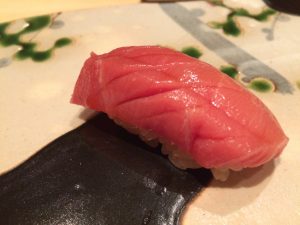
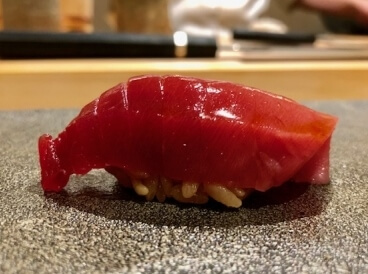
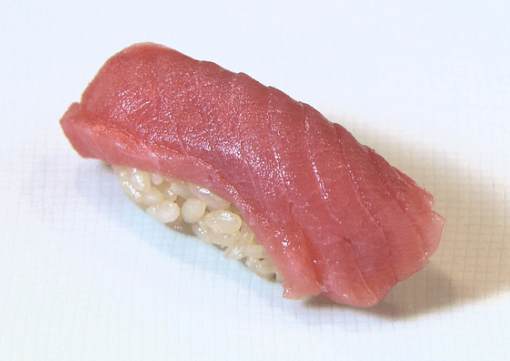
Also called Chutoro. The fat content of medium fatty tuna (chutoro) is about 15 to 20%. This is lower than very fatty tuna (otoro), but it has a smooth texture and it also feels like it melts in your mouth.
At high-class restaurants, the minimum required nikiri soy sauce is brushed on to the piece, but at restaurants frequented by the general public, customers dip their sushi in as much sauce (soy sauce that includes chemical seasonings) as they like. In fact, there is a gimmick here. The high-class restaurant provides an opportunity for their customers to eat sushi toppings in the most delicious state possible, but the restaurants for the general population allow customers to eat casually with sauce, a daily necessity. This changes how topping ingredients are selected. If the sushi is going to be dunked into the soy sauce, then the topping must have an appropriate fat content that won’t be overpowered by the soy sauce. Therefore, instead of a coastal tuna, a farm-fattened tuna with oily fat is preferred. It is often said that farm-fattened products are too rich, but it is also said that they have an impact that isn’t overpowered by the sauce they are enjoyed with.
Tuna caught in the coastal regions of the Japan Sea is notable as the best bluefin tuna in January. Iki, a small island in Kyushu area is one of the famous ports for tuna.
In February and March, the tuna auction market becomes slack due to rough weather. Just a few tunas from Nachikatsuura where is also the famous port for tuna are on the market.
In March and April, tunas become thin because their eggs need many nutrients.
In May, large tuna is seldom seen in the Tsukiji Fish Market. Even if there is, its body is really thin. “Kinkaimono” which means a shore-fish is generally considered as high-class tuna, but in this season, imported tuna is useful instead.
It is said that Pacific Bluefin tunas spawn around Japanese waters between Taiwan and Okinawa in April and May. And then, they go up to fertile, north sea along the eastern coast of Japan.
In June, “Chubo” which is young and small tuna is taken hugely off the coast of the Sea of Japan. The school of Chubo begin moving northward in this season.
In July and August, tunas can be seen occasionally but their bodies are still thin. Instead, Boston Tuna which is caught in the Atlantic Ocean and nicknamed “Jumbo” is on the market. Its fresh is softer than “Kinkaimono” and it doesn’t have medium-fatty part which “Kinkaimono” has.
In September, Boston Tunas are at their best with plenty of fat on them. The best season of Boston Tuna is limited and ends in October. But fortunately, Japanese tunas come into season.
The school of tunas split up into two groups, the one takes Pacific Ocean route and another takes the Japan Sea route and both of them move northward along the Japanese Islands. Some of them reach the Tsugaru Strait where and the season of Tuna begins from September to next January. Oma town and Toi town is famous nationwide for its catch of tuna from the Tsugaru Strait. The flavor of tuna in September is still weak but it becomes stronger in October. In November, feed of tunas such as Pacific saury or Japanese common squid with plenty of fat increase and flavor of tuna also gets stronger. In December, the peak season comes around.
A catch of tuna falls off in January and it enters the final season. The temperature of sea water gets cold and feed of tuna, squids decrease and the fishing season in this area ends.
The bluefin tuna goes by different names in Japanese depending on its age. It starts out as “Meji (メジ or メジマグロ),” grows into “Chubou (中坊)” and finally is called Maguro (once it’s 50 kg or more).
Meji is less than 1 year old and weighs around 20 kg.
Chubou is an old word for relatively low-class Buddhist priests who were treated as errand boys. I guess it was meant to imply that these boys were even weaker than tuna. At this stage, the fish are between 2-5 years old and weigh about 40kg.
Anything larger than that is called Maguro. The biggest is 3m long and 600kg or more. Especially large tuna is called Shibi. “Shibi” comes from the Japanese characters for “4-days”, which is how long the fish takes to mature.
Most Meji and Chubou are caught from May until the beginning of autumn when Maguro is thin and tasty.
Meji has a unique scent and taste that sets it apart from full-grown tuna. The color is similar to the skipjack rather than bluefin. On the other hand, Chubou has a lighter color and it isn’t as rich, but the flavor is young, refreshing tuna. That is why Meji is considered to be a completely separate sushi topping and Chubou is presented to be a type of tuna.
Large fish that are caught are always kept and transported on their side with their heads facing left from the port to the market and to the restaurant where they are served. The part of the fish facing down when in this position is called “Shitami” or the “bottom body” and the part facing up is called “Uwami” or the top body. The Uwami costs more than Shitami. This is because the Shitami takes on the weight of the Uwami, reducing the freshness and possibly causing cracks in the body (cracking occurs on the edges of the muscles).
This mostly applies to Pacific bluefin tuna (tuna that is consumed without any freezing after being caught). At any rate, since this fish costs hundreds of dollars per kilogram, a full-grown fish may be worth more than a luxury sports car. Therefore, from the time they make their catch, the fishermen work quickly, which affects all aspects of the quality. Most of all, this work affects the price. A Pacific bluefin is never placed directly on the deck of the ship. If a fish weighing 100 kg or more is set directly on the hard deck, its own weight would cause injury to its surface. Naturally, any damage or injury to the fish reduces the price. Instead, each fish is laid on a soft, spongy mat to protect its skin surface. Next, the blood is drained, the spinal cord nerves are destroyed and the fish is submerged in ice water. It might be easier to understand if you imagine handling a luxury vehicle, like a Ferrari, rather than a tuna fish.
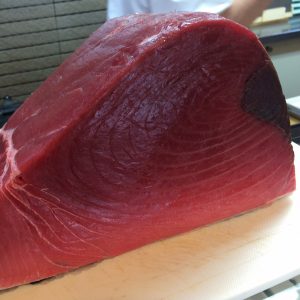
A purchase of raw tuna costs at least JPY 30,000 per kilogram. Furthermore, good tuna is judged not only by taste, but appearance is also highly regarded.
The surface is gradually oxidized by letting it sleep (mature) and the sushi chef makes sure that parts are cut of as they change color, when the timing is perfect for both the taste and appearance. In other words, skin is taken from the freshly purchased tuna, the meat of the fish darkened by blood (the blackened area that can’t be used as sushi toppings) is removed, the parts that have changed color are shaved off and then only the remaining, best parts used as toppings are left.
During the Edo period, tuna was not highly valued as a sushi topping and it was referred to as “Gezakana” meaning that it was inferior to normal fish. The reason was the big size of the tuna. At this time there was no ice, so tuna had to be salted. It was cut into blocks, salt was spread all over and in it, and that was it. At Uogashi (the market prior to Tsukiji) it was treated at shops that specialized in salting fish. The dark, discolored, salty chunks of flesh really were nothing but “Gezakana*”.
*Gezakana -Relatively low-cost sushi ingredients, such as gizzard shad and horse mackerel. Bluefin tuna used to be also called gezakana in the Edo period, for losing its freshness easily.
A single bite of the same bluefin tuna differs greatly depending on the part of the fish it came from.
The body of the fish is broadly categorized into the dorsal (back) and the ventral (belly) sides, which taste completely different. Of course the meat near the head tastes completely different from the meat near the tail. If you dig even deeper, there are parts that aren’t as well-known as the Otoro (fatty), Chutoro (medium fatty) and Akami (lean) tuna meats. We’d like to explain those now.
“Hachinomi (ハチの身) or Tsunotoro Nouten” is the meat from the crown of the head. It is fatty and rich and also called “Head Toro”. Only about 1kg of this precious meat can be taken from even a very large fish, and it is only shared with regular, loyal customers.
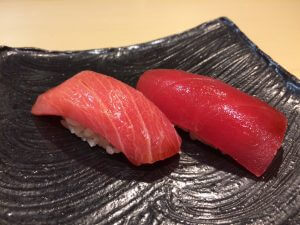
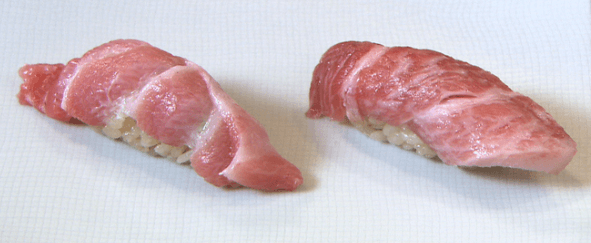
“Kamatoro (カマトロ)” is taken from behind the jaw. It is known as “shimofuri (霜降り)” or marbled meat. There are no veins in this part so the meat is soft and the marbling is more detailed than Otoro, so it is sticky and melts in your mouth. The balance of fat and sweetness in this part is unparalleled. It can be said that otoro (such as shimofuri and jabara) of tuna is the representative part of toro tuna. This is an image of the shimofuri on the right, and the jabara (蛇腹) on the left.
“Chiai (血合い)” is the part with the most veins, so it is a dark red color. It has a strong odor of blood and has multiple times the acidity of the lean meat, so it is not used as a sushi topping.
“Chiai Gishi (血合いぎし)” -Located right next to chiai, this is the meat you can taste the umami of the rich red meat and the sweetness of toro fat at the same time.
“Wakaremi (分かれ身)” is a precious part with very little meat found next to the dorsal fin. The part especially close to the dorsal fin is popular and called “Setoro (背トロ)”. Setoro has both the umami of akami and the umami of fat. The fat isn’t overbearing so you can eat a ton. However, this part is hard to get, even in high-quality tuna and is not available except to regular customers in almost all sushi restaurants.
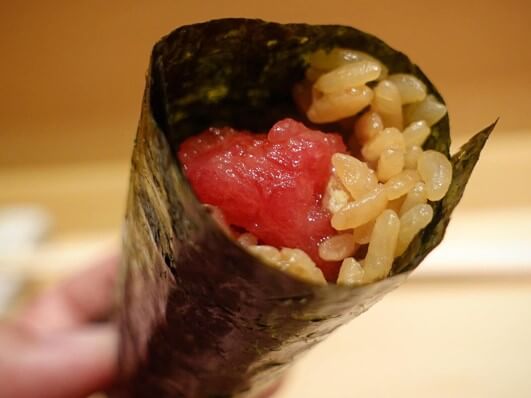
A sushi chef, Hiroyuki Sato, serves a tossaki hand roll as the first sushi piece of the course. “Tossaki (突先)” is an exclusive cut of tuna that goes well with sushi rice using red vinegar, which is less sour but has more umami and flavor compared with white vinegar. Because tossaki is the base of the tuna’s head and it moves a lot, there are a lot of muscular striations. Therefore it needs to be prepared using the back of a knife carefully as if peeling it off (Hagashi). It is said that tossaki is a high-tuna-flavor cut. A couple of Sato’s apprentices also offer a hand roll to open up the meal in the same way.
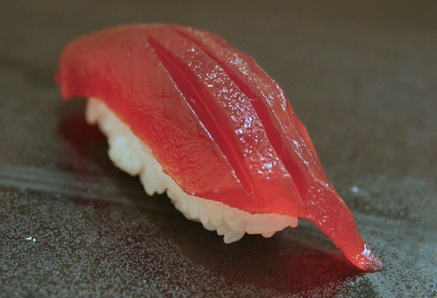
The meat of tuna gets leaner and muscular striations are fewer towards the inner center of the body. “Tenpa (天端)”, surrounding the spine, is deeper in color and tastes stronger. It features the tender texture coming from the finest meat quality. This is also called Tenmi (天身).
“Hohoniku (ホホ肉)” or cheek meat is taken from below the eye, seasoned, grilled and made into gun-kan rolls. The taste is enhanced in this part by grilling.
“Hireshita (ヒレ下)”-Located right above the first pectoral fin. Characterized with the tender meat which is relatively low in fat content but rich with umami flavor. This truly is the valuable part of whether there will be even enough for 10 pieces of sushi from an over 200 kg tuna.
If you are fortunate enough to get an opportunity to taste these, you can take it as proof that you have been accepted as a regular and loyal customer. It is difficult to distinguish these parts by appearance alone, so make sure you try them at a sushi restaurant you can trust. Just for your reference.
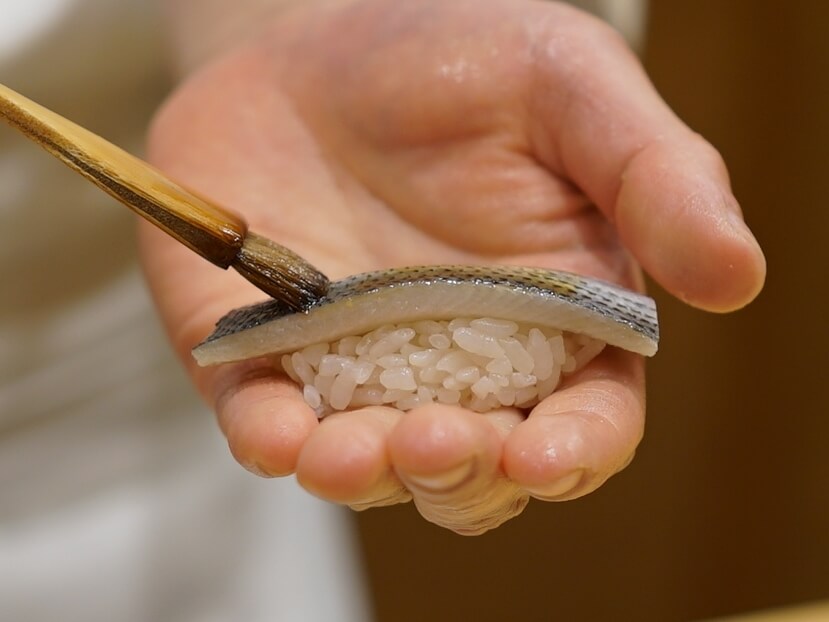 At high-class restaurants, the minimum required nikiri soy sauce is brushed on to the piece, but at restaurants frequented by the general public, customers dip their sushi in as much sauce (soy sauce that includes chemical seasonings) as they like. In fact, there is a gimmick here. The high-class restaurant provides an opportunity for their customers to eat sushi toppings in the most delicious state possible, but the restaurants for the general population allow customers to eat casually with sauce, a daily necessity. This changes how topping ingredients are selected. If the sushi is going to be dunked into the soy sauce, then the topping must have an appropriate fat content that won’t be overpowered by the soy sauce. Therefore, instead of a coastal tuna, a farm-fattened tuna with oily fat is preferred. It is often said that farm-fattened products are too rich, but it is also said that they have an impact that isn’t overpowered by the sauce they are enjoyed with.
 During the Edo period, tuna was not highly valued as a sushi topping and it was referred to as “
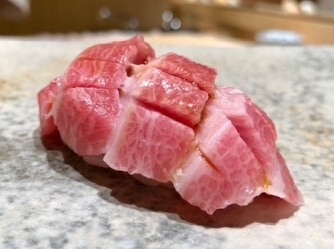 A single bite of the same bluefin tuna differs greatly depending on the part of the fish it came from.
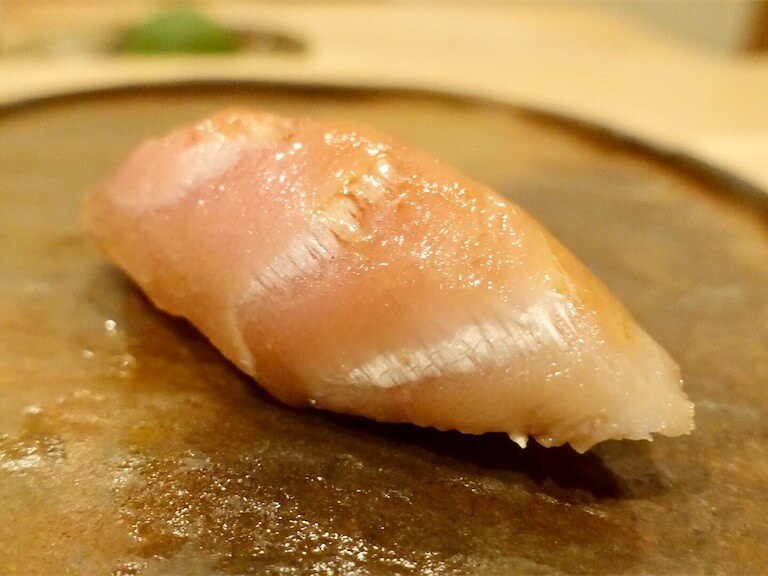 “
“ “
“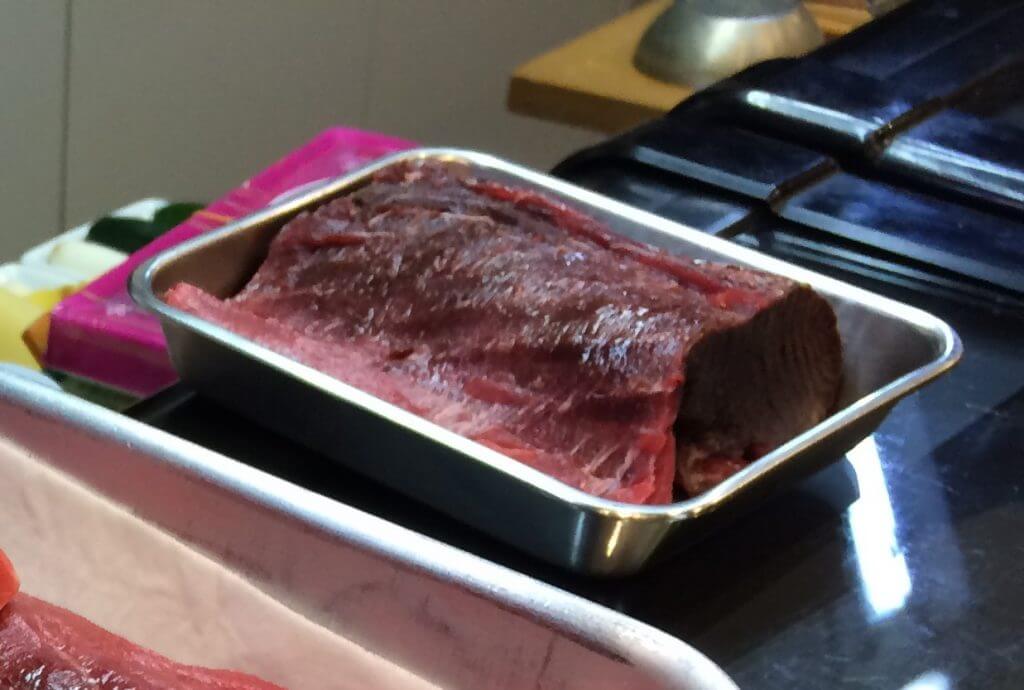 “
“ “
“
 A sushi chef, Hiroyuki Sato, serves a tossaki hand roll as the first sushi piece of the course. “
 The meat of tuna gets leaner and muscular striations are fewer towards the inner center of the body. “
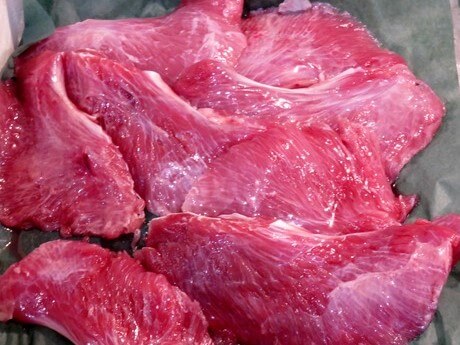 “
“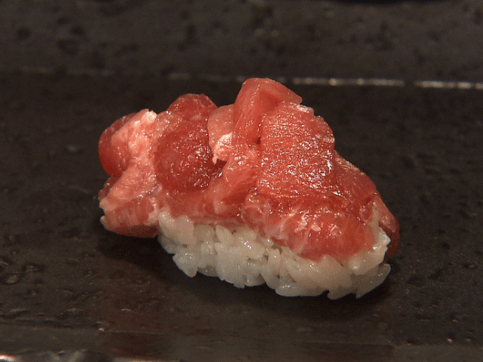 “Hireshita (ヒレ下)”