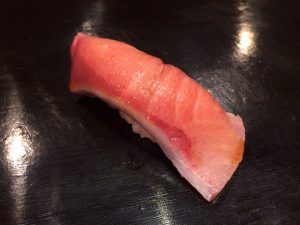
Marbled tuna(shimofuri) is the part in which it looks like the fat has fallen like a frost and melts like snow on your tongue then leaving only the umami taste.
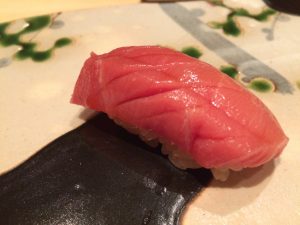
The lined fatty tuna (Jabara) is the part that has white fat lines running through it. When you first take a bite, surge of aroma and umami flavor fills your mouth. After that, the potent fatty umami fills your mouth. The way the fat melts in your mouth differs between Jabara and marbling, so which you like better depends on preference.
This is a list of 10 must-try sushi toppings in April. Sayori has long been loved the Japanese as an ingredient in Edomae sushi, and its appearance ushers in the start of spring. And katsuo (bonito) is recommended for this day, and of course, this is the time for “Hatsugatsuo” (the first bonito of the season).
Meji Maguro (AKA: Meji) caught in fixed net fishing is one type of sushi topping that you really should try. Meji is the larval fish of Pacific bluefin tuna, made and served at expensive restaurants, but not usually available as Edo-style sushi. Its fat is lighter and it doesn’t have the impact that fatty tuna has. Efforts are put into seasoning to avoid this. Using a pinch of ginger, Japanese basil or onion between the topping and rice, along with the wasabi, really brings out the fresh flavor of the young fish as well as the sweetness of this fatty part.
One of the pleasures of sitting at a sushi counter is watching the sushi master work his craft.
He holds the topping between the index finger and thumb of his left hand while simultaneously grabbing the shari (vinegar rice) with his left hand. He gently squeezes the shari and then moves the topping from his left hand to the top of that shari in a fluid motion. This entire process of shaping the shari to the finished piece of sushi takes less than six seconds. Every movement is precise and purposeful.
However, no matter how many pieces the chef makes one after another, you’ll never see a grain of rice stick to his hands. If you or I were to make even one piece of sushi, our hands would be covered in rice. So why doesn’t it happen to them? Their hands don’t look oiled. Perhaps sushi chefs have especially smooth or slick hands compared to us average Joes?
Of course not. This is actually thanks to the vinegar.
The chefs keep a bowl of vinegar close by, which they constantly use to wet their hands. This procedure is called “Tezu” or vinegared water, which both disinfects the hands and cools their palms. When the vinegar evaporates, it takes the heat from the hands with it.
Normally hands reach temperatures of 33-34 degrees Celsius (91-93 degrees Fahrenheit), but sushi chefs cool their hands to approximately 30 degrees Celsius (86 F). This transfers the heat from the hands to the shari, keeping it from getting sticky. In other words, not a single grain of rice sticks to their hands.
The most delicious time to eat fish differs depending on if it is served as sashimi, as sushi, or boiled. Fresh does not necessarily mean delicious. For example, Japanese Amberjack should be used in sashimi 3-5 days after being caught, in sushi a week after being caught and it can be used in a stew or boiled once it turns black around the edges. This is because the inosine acid, which is responsible for the umami taste, increases after rigor mortis ends and understanding the timing of the peak in flavor is up to the skill of the sushi chef.
Thicker cuts of fish are used for sashimi than for sushi. Depending on the restaurant, the equivalent of three pieces of sushi may be used in one cut of sashimi. In other words, two pieces of sashimi is the same as six pieces of sushi. At a restaurant where one piece of medium fatty tuna sushi is priced at JPY 1000, simple arithmetic prices medium fatty tuna sashimi at JPY 6000. Just a small order of assorted sashimi often costs more than JPY 10,000. Be careful.
This is a list of 10 must-try sushi toppings in March. This is the season when early cherry blossoms start to bloom. On the spring equinox, fishing for Japanese egg cockle (Torigai) opens.
One theory is that this practice is leftover from back when pieces of sushi were made larger and then cut in half. But, there are also some toppings that are better to eat in pairs.
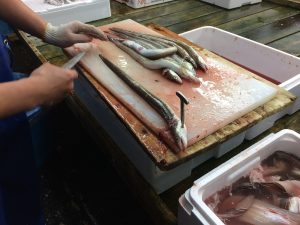
For example, conger eel tastes completely different when one piece is eaten with salt and the other seasoned with sweet sauce. Serving the piece with the head skin-up and the piece with the tail belly-up also offers different textures. Since the back and belly of bonito have different fat content, it can be better to order two pieces at a time in order to fully experience each of the individual qualities of the fish.
Many overseas visitors who aren’t used to eating fish have an aversion to fishy smells. This is actually the smell of a substance called trimethylamine and is generated by the breakdown of the umami component called trimethylamine oxide found in large amounts in fish by bacterial growth. The smell also gets stronger with the generation of ammonia as more time passes.
Bacterial growth can be controlled with refrigeration so toppings at sushi restaurants are kept cold. Trimethylamine is an alkaline, so smells can be eliminated by washing with vinegar, which is acidic. It is also possible to kill bacteria on the surface of the fish by soaking it in vinegar, reducing the number of bacteria. Basically, sushi restaurants are constantly taking measures to prevent bacterial growth and avoid fishy smells.
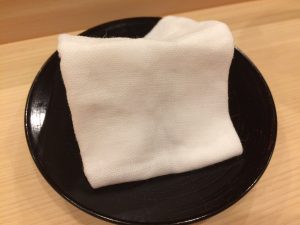
Sushi was originally a food eaten with your hands. Even, for example, if you are in a prestigious sushi restaurant in Ginza, you can still eat with your hands. You can actually use your hands to eat the ginger too. Restaurants that prefer you to eat with your hands will provide an extra, smaller towel for cleaning your hands between sushi, along with the normal hand towel. Even then, feel free to use chopsticks if you prefer.
A purchase of raw tuna costs at least JPY 30,000 per kilogram. Furthermore, good tuna is judged not only by taste, but appearance is also highly regarded.
The surface is gradually oxidized by letting it sleep (mature) and the sushi chef makes sure that parts are cut of as they change color, when the timing is perfect for both the taste and appearance. In other words, skin is taken from the freshly purchased tuna, the meat of the fish darkened by blood (the blackened area that can’t be used as sushi toppings) is removed, the parts that have changed color are shaved off and then only the remaining, best parts used as toppings are left.
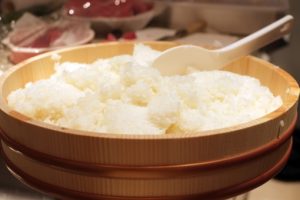
From the end of the Edo period through the Meiji period, rice was cooked using firewood and a pot. It is not easy to get the fire at the right temperature and the rice has to be cooked to the same texture regardless of where it came from or the size of the grains, so at the time the task required a skilled chef. Therefore, there were “Shari-ya” employed by sushi restaurants who specialized in cooking rice. “Shari-ya” focused on this single task and were not involved in the actual making of the sushi after the rice was passed on to the chefs.
This is a list of 10 must-try sushi toppings in February. Hamaguri was once harvested in abundance from Tokyo bay, and even today is a fundamental ingredient in Edomae sushi.
There are manners in using chopsticks that tourists may be unaware of. I would like to introduce some of those here.
First of all, it is impolite to place chopsticks on your dish in the middle of a meal. Make sure to place them back on the chopstick stand when you aren’t using them.
It is also poor manners to stab food with chopsticks and or to use chopsticks to look through dishes. Please avoid breaking up the beautifully arranged dishes when you eat.
During the Edo period, tuna was not highly valued as a sushi topping and it was referred to as “Gezakana” meaning that it was inferior to normal fish. The reason was the big size of the tuna. At this time there was no ice, so tuna had to be salted. It was cut into blocks, salt was spread all over and in it, and that was it. At Uogashi (the market prior to Tsukiji) it was treated at shops that specialized in salting fish. The dark, discolored, salty chunks of flesh really were nothing but “Gezakana*”.
*Gezakana -Relatively low-cost sushi ingredients, such as gizzard shad and horse mackerel. Bluefin tuna used to be also called gezakana in the Edo period, for losing its freshness easily.
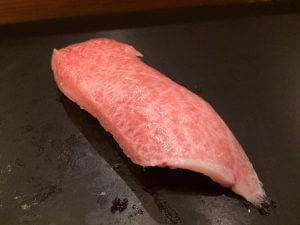 Marbled tuna (shimofuri) is the part in which it looks like the fat has fallen like a frost and melts like snow on your tongue then leaving only the umami taste.
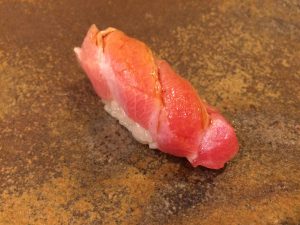 The lined fatty tuna (Jabara) is the part that has white fat lines running through it. When you first take a bite, surge of aroma and umami flavor fills your mouth. After that, the potent fatty umami fills your mouth. The way the fat melts in your mouth differs between Jabara and marbling, so which you like better depends on preference.
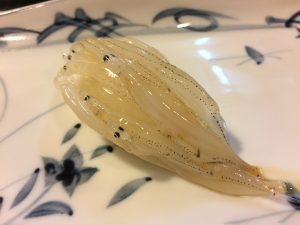
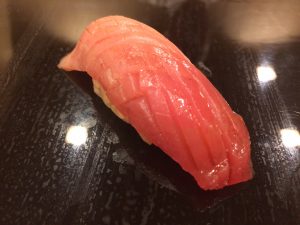
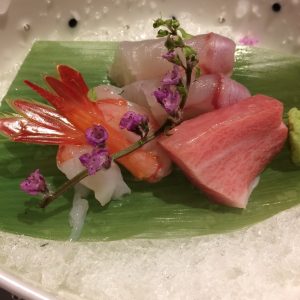 Thicker cuts of fish are used for sashimi than for sushi. Depending on the restaurant, the equivalent of three pieces of sushi may be used in one cut of sashimi. In other words, two pieces of sashimi is the same as six pieces of sushi. At a restaurant where one piece of medium fatty tuna sushi is priced at JPY 1000, simple arithmetic prices medium fatty tuna sashimi at JPY 6000. Just a small order of assorted sashimi often costs more than JPY 10,000.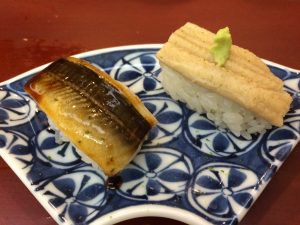
 Many overseas visitors who aren’t used to eating fish have an aversion to
  Sushi was originally a food eaten with your hands. Even, for example, if you are in a prestigious sushi restaurant in Ginza, you can still eat with your hands. You can actually use your hands to eat the ginger too. Restaurants that prefer you to eat with your hands will provide an extra,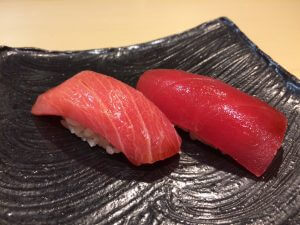
 From the end of the Edo period through the Meiji period, rice was cooked using firewood and a pot. It is not easy to get the fire at the right temperature and the rice has to be cooked to the same texture regardless of where it came from or the size of the grains, so at the time the task required a skilled chef. Therefore, there were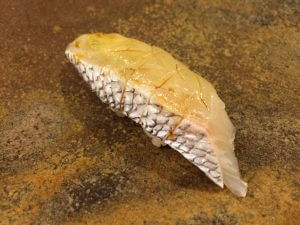
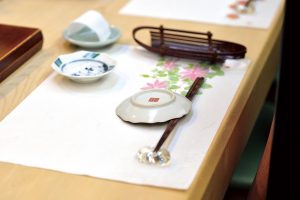 There are manners in using chopsticks that tourists may be unaware of. I would like to introduce some of those here.
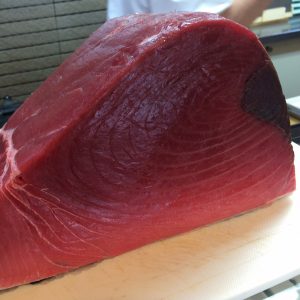 During the Edo period, tuna was not highly valued as a sushi topping and it was referred to as “