Ginger is used for toppings with a strong, distinct taste and strong fishy smell such as bonito, horse mackerel and sardines.
Wasabi has a spicy taste and stimulates the senses of taste and smell and works to dull the senses so the fishy smell is not felt, but ginger is effective in actually extinguishing the fishy smell.
Laying the chopsticks sideways as if scooping up the sushi distributes the strength and the sushi won’t break easily. If you grab it in the middle then there will be too much force on that part and it will break in two pieces. Make sure to eat this beautifully formed piece of sushi in one bite.
A single bite of the same bluefin tuna differs greatly depending on the part of the fish it came from.
The body of the fish is broadly categorized into the dorsal (back) and the ventral (belly) sides, which taste completely different. Of course the meat near the head tastes completely different from the meat near the tail. If you dig even deeper, there are parts that aren’t as well-known as the Otoro (fatty), Chutoro (medium fatty) and Akami (lean) tuna meats. We’d like to explain those now.
“Hachinomi (ハチの身) or Tsunotoro Nouten” is the meat from the crown of the head. It is fatty and rich and also called “Head Toro”. Only about 1kg of this precious meat can be taken from even a very large fish, and it is only shared with regular, loyal customers.
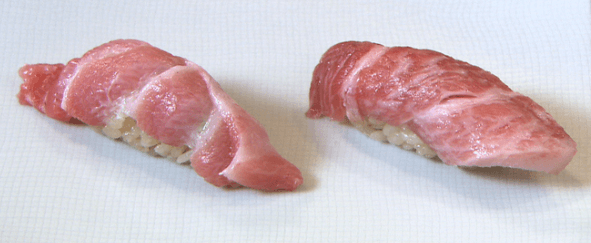
“Kamatoro (カマトロ)” is taken from behind the jaw. It is known as “shimofuri (霜降り)” or marbled meat. There are no veins in this part so the meat is soft and the marbling is more detailed than Otoro, so it is sticky and melts in your mouth. The balance of fat and sweetness in this part is unparalleled. It can be said that otoro (such as shimofuri and jabara) of tuna is the representative part of toro tuna. This is an image of the shimofuri on the right, and the jabara (蛇腹) on the left.
“Chiai (血合い)” is the part with the most veins, so it is a dark red color. It has a strong odor of blood and has multiple times the acidity of the lean meat, so it is not used as a sushi topping.
“Chiai Gishi (血合いぎし)” -Located right next to chiai, this is the meat you can taste the umami of the rich red meat and the sweetness of toro fat at the same time.
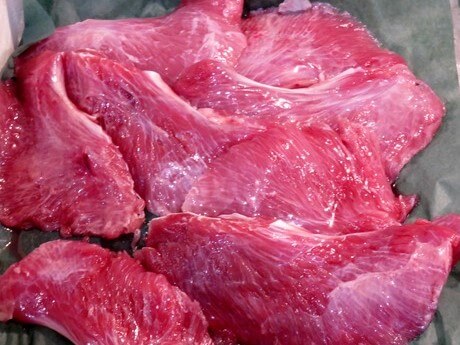
“Wakaremi (分かれ身)” is a precious part with very little meat found next to the dorsal fin. The part especially close to the dorsal fin is popular and called “Setoro (背トロ)”. Setoro has both the umami of akami and the umami of fat. The fat isn’t overbearing so you can eat a ton. However, this part is hard to get, even in high-quality tuna and is not available except to regular customers in almost all sushi restaurants.
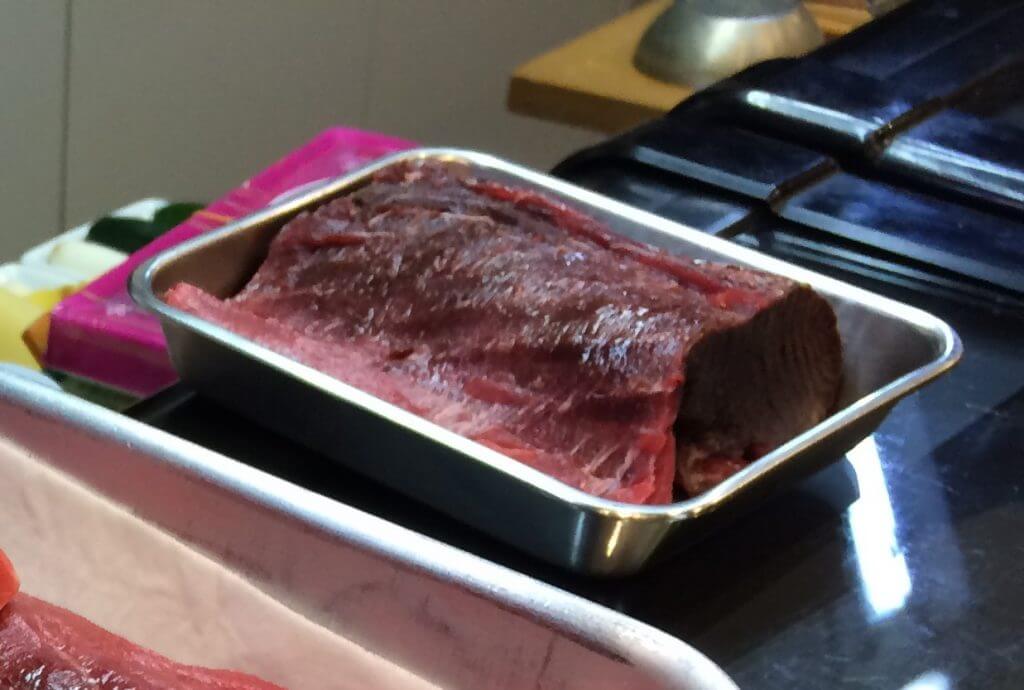
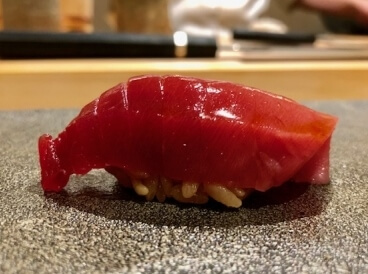
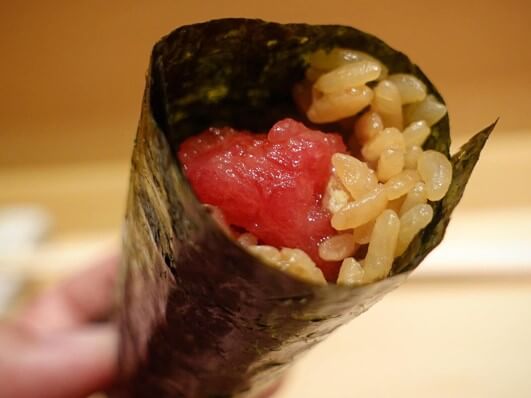
A sushi chef, Hiroyuki Sato, serves a tossaki hand roll as the first sushi piece of the course. “Tossaki (突先)” is an exclusive cut of tuna that goes well with sushi rice using red vinegar, which is less sour but has more umami and flavor compared with white vinegar. Because tossaki is the base of the tuna’s head and it moves a lot, there are a lot of muscular striations. Therefore it needs to be prepared using the back of a knife carefully as if peeling it off (Hagashi). It is said that tossaki is a high-tuna-flavor cut. A couple of Sato’s apprentices also offer a hand roll to open up the meal in the same way.
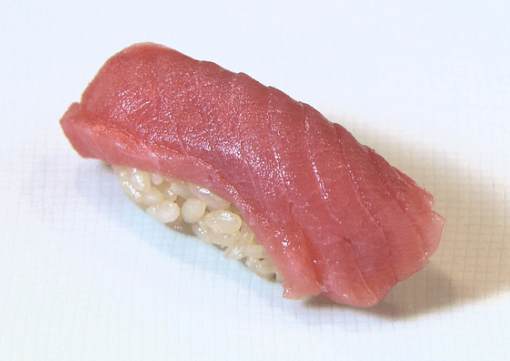
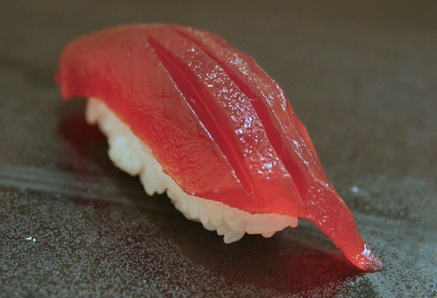
The meat of tuna gets leaner and muscular striations are fewer towards the inner center of the body. “Tenpa (天端)”, surrounding the spine, is deeper in color and tastes stronger. It features the tender texture coming from the finest meat quality. This is also called Tenmi (天身).
“Hohoniku (ホホ肉)” or cheek meat is taken from below the eye, seasoned, grilled and made into gun-kan rolls. The taste is enhanced in this part by grilling.
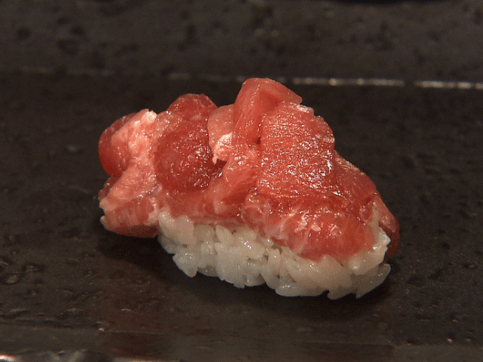
“Hireshita (ヒレ下)”-Located right above the first pectoral fin. Characterized with the tender meat which is relatively low in fat content but rich with umami flavor. This truly is the valuable part of whether there will be even enough for 10 pieces of sushi from an over 200 kg tuna.
If you are fortunate enough to get an opportunity to taste these, you can take it as proof that you have been accepted as a regular and loyal customer. It is difficult to distinguish these parts by appearance alone, so make sure you try them at a sushi restaurant you can trust. Just for your reference.
There are mainly five methods for tuna fishing. “Ipponzuri” (catching fish with fishing poles) in Oma, Aomori prefecture, you see a lot through the media, is well known. However, the fact is that Long line fishing method and Purse seine fishing method are the ones catching the most tuna. The rest is Fixed net fishing method and Hikiami (Seine fishing method).
<Long line fishing method>
To hang a long line (Mikinawa) in the sea, covered with about 3000 fishhooks attached to branch lines (Edanawa), aiming at a path of schooling tuna.
<Purse seine fishing method>
A large-scale method of fishing by encircling a school of tuna with a net. Although it is efficient, there is a demerit of lowering the quality of fish because they struggle while getting caught. In addition, other kinds of fish and immature fish can be caught without distinction and that leads to overfishing.
<Fixed net fishing method>
Tuna have a habit of migrating to the same ocean area at the same time each year. A coastal fishing method called Fixed net fishing consists of placing a net in the sea and wait for a school of tuna. The advantage of this method is to be able to capture the fish alive without causing any injury or damage.
<Ipponzuri (catching fish with fishing poles)>
This method has the longest history and uses a pole of 4 – 6 meters to fish from a boat. Using a machine that winds up lines automatically and also using human hands, pull up tuna that weighs more than 100kg and lastly catch it by piercing gills with a harpoon.
<Hikiami (Seine fishing method)>
To catch fish by towing a bag-shaped net from a boat.
The natural salmon roe season is the autumn. Does this mean that most of the roe eaten during the off-season is artificial Salmon roe. Not necessarily. As stated in his biography, even at the famous sushi restaurant Sukiyabashi Jiro, frozen roe is thawed as necessary.
Long ago this was an extremely expensive topping that ordinary people couldn’t afford, so artificial roe was used. There was a time when this was the case. But nowadays salmon roe is regularly imported from overseas and can be obtained cheaper, eliminating the need to use artificial roe instead.
However, we cannot overlook the commercial law for passing off artificial roe as natural roe. In Japan, the non-perishable properties of artificial salmon roe made from chemical substances (mainly sodium alginate) is utilized and used mainly in hospitals, but not sold to the general public. I’ll also tell you that it is very rare to find a sushi restaurant that serves artificial roe. Cheap roe is generally made from eggs of trout, other related species, or imported from Canada and other countries.
Unfortunately I’m not familiar with the state of things outside of Japan, but I can tell you how to tell the difference. All it takes is hot water and a moment of observation. Artificial salmon roe will show no changes in hot water, but natural roe will start to turn white on the surface. This is due to the protein reacting and changing with the heat. That said, this is not an experience you can just set up at the sushi restaurant.
As an aside…
What are the fish eggs on sushi called in Japan?
There are eight types of fish eggs served at Japanese sushi restaurants. However, not all of them are used for Nigiri sushi. Some are served as side dishes. Uni is sometimes translated as sea urchin’s roe, but it is actually the sea urchin’s genitals (testes and ovaries). Most people also don’t know that Tobiko and Tarako are not served at 99% of Edo-style restaurants. In other words, these toppings are only served at kaiten-sushi (conveyor belt) restaurants. The one type of roe topping that can probably be found at all sushi restaurants is Ikura. Even more types of fish eggs, such as Masago, Paddlefish roe and Hackleback roe are used in sushi overseas, but Japan remains more conservative. Of course, it’s only natural that fish substitutes are not well-received in the place where sushi was born.
Types of fish roe
What is Ikura? - It is Salmon roe.
What is Kazunoko? - It is Herring eggs.
What is Sujiko? - It is Salmon roe that is still within its egg membrane.
What is Tobiko? - It is Flying fish roe.
What is Tarako? - It is Walleye pollock roe.
What is Caviar? - It is Sturgeon roe.
What is Karasumi? - It is Dried mullet roe.
What is komochi konbu? - It is Herring spawn on kelp.
If you visit a premium sushi restaurant, such as one that places piles of salt by the entrance for good fortune, you’ll notice there are no price displays.
There’s not even a menu. All you find is a slab of wood hanging down the wall with names of the daily offerings such as Conger Eel (anago) or Spotted Shad (kohada).
This is not a place to get angry and ask how customers can order without knowing the price. First time customers may not know the market price and worry about budget, resolving to pay with a credit card if they don’t have enough cash in their wallet.
I guess you could say that sushi restaurants that don’t display prices are accepted by customers as being more traditional, like the old days. But actually, at pre-war sushi restaurants, there were wooden panels that listed prices such as “Fatty Tuna: 2000 yen”. It was during the 1960s that they stopped displaying prices.
The 60s was the start of an era of high-growth in Japan. Prices were rising rapidly and sushi prices also went up drastically. At the same time, the business practice of entertaining clients was gaining popularity and suddenly about 80% of the clientele of high-quality sushi restaurants were these types of business groups, rather than individual customers.
In situations like these, if there was a sign that read “Medium Fatty Tuna: 3000 yen” then it makes it difficult for the business guest to order what they like, without worrying about the price. Considering the total bill, they may also order fewer dishes than they want. As you can see, this practice of not displaying prices at sushi restaurants was in consideration for the business customers who were entertaining clients, as well as those being entertained as clients. At the same time, the well-known “Omakase” was created, the “chef’s choice” system in which the customer orders a menu created by the chef on the spot.
There are many different things all over the world that are share the name “sushi”. However, when Japanese people hear this word they think of “nigiri sushi”. Of course outside of Japan, it probably more commonly refers to sushi rolls.
Similarly, the way soy sauce is used also differs greatly between people in Japan and those in other countries. The soy sauced used for nigiri sushi is not used to add salty flavor to the sushi. The reason it’s used is to subdue the fishy odor of the fish and to add the many amino acids contained in soy sauce to nigiri sushi, which brings out the umami synergistic effects. Think of it more like an important background role to the sushi that isn’t meant to stand out. Meanwhile, since sushi rolls and other sushi dishes overseas are generally eaten after being cooled, the flavor is subdued, leading to using large amounts of soy sauce.
There is also a big difference in the concept of sushi sauce. In Japan, there is no such word as “sushi sauce”. Neither chefs nor the general population has heard this term. However, the term is easy to imagine what it would be, so hearing the word “sushi sauce” would probably lead Japanese people to assume it meant nikiri shoyu or nitsume, which are used in nigiri sushi. Also, soy sauce, or “shoyu” as it’s called in Japanese, is not considered to be a type of “sauce” in Japan. But what about in other countries? Sushi sauce has a distinctive, assertive flavor and is added to bring out multiple layers of flavor. There are also many types of sushi sauce such as sriracha sauce, spicy mayo, mango sauce, ponzu sauce, tonkatsu sauce, eel sauce, tamari sauce, teriyaki sauce, dynamite sauce and others. They each play an important role in bringing out the flavors of sushi rolls that otherwise wouldn’t be apparent.
In other words, as the definition of sushi definition changes across borders, the definition of sushi sauce changes too. However, what both sushi sauce overseas and Shoyu in Japan have in common is that they complement the sushi they are used for.
Now we would like to explain a bit about the Shoyu used in nigiri sushi.
Edo style sushi was created during the Edo period in Japan (1804-1830). The expansion of the soy sauce culture of the Edo area (currently Tokyo) had a big influence on the creation of Edo style sushi. In a time when refrigeration and other technology had not yet been developed, soy sauce played an important role not only in taste, but also in preservation. A surprising number of tasks in the Edo style utilize the scientific effects of soy sauce.
First of all, lightly applying just a small amount of Nikiri shoyu (sushi sauce) on the sushi topping, brings out its flavor and creates a glaze. To put it scientifically, this a clever use of the odor eliminating effects of soy sauce, eliminating the raw odor.
Also, long ago zuke (soaking in soy sauce) was also used for fish other than tuna. This was a way to utilize the bacteriostatic effects of soy sauce, which stop the growth of Escherichia coli (E. coli).
Tsume (sushi sauce) represents the thermal effects of soy sauce. By adding soy sauce, mirin and sugar then boiling down, the amino acids in the soy sauce and the sugar react and the goal is to create a delicious glaze and a nice scent that stimulates the appetite.
Adding a small amount of soy sauce when making rolled egg omelets has the effect of enhancing and bringing out the flavor and sweetness of the ingredients.
Soy sauce is generally overshadowed by the sushi topping and vinegar rice, but soy sauce plays an important role in bringing out and enhancing the delicious taste of the sushi.
Sushi Sho (in Yotsuya) is a restaurant where you cannot make a reservation easily. Its founder, Keiji Nakazawa, can be described with a keyword of having raised so many disciples. And the point, they run sushi restaurants that are also hard to make reservations, leads to how Nakazawa’s ideal sushi master should be. Having such a great intriguing personality, Nakazawa left his safe haven “Sushi Sho” in the hands of disciples. September 2016, he opened up Sushi Sho (in Hawaii) in The Ritz-Carlton Residences, Waikiki Beach on Oahu. We can’t take my eyes off that now.
Kozasazushi (in Shimokitazawa) was opened by the legendary sushi chef, Shuzo Okada (passed away in May 2004). His successor, Tsutomu Nishikawa was, of course, his apprentice. The Omakase course is not an option at this restaurant. The only way to order is to look at the topping board and choose for yourself. This is a shop for experts and may be difficult for guests who can’t read or speak Japanese.
Address:3-7-10 Daizawa Setagaya-ku, Tokyo (10 minutes walk from Shimokitazawa Station)
It is true that in an age when aquatic resources are being depleted, there is a worldwide demand for a substitute for luxurious fish. However, although it’s not easy to tell fish apart once it’s sliced, that doesn’t mean that restaurants should not be held to certain standards. Here we present a number of severe cases.
First of all, Opah belly meat with some fat is used for the tuna in Negi-toro (tuna minced with Welsh onion leaves). Opah is widely distributed in warm seas and it’s known to be inexpensive with a smooth taste. The price is less than 1/100 of the Pacific bluefin tuna and if possible Negi-toro made from Opah should be avoided.
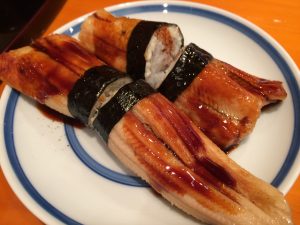
Next let’s discuss Japanese conger, an essential Edo-style sushi topping. A substitute for Japanese conger is the Common snake eel, which is a type of sea snake from Peru. The taste is pretty good, but the skin is rubbery and it doesn’t stick to the Shari (vinegar rice) so it’s instantly apparent that it’s a substitute fish. If you find Japanese conger at kaiten-zushi for JPY 100 per plate, you might want to question the source.
A premium sushi topping is the Mirugai clam (also called Hon-miru). This shellfish is characterized by its unique texture and taste. Instead the Japanese geoduck (Shiro-miru) is used, which sells for half the market price. However, the taste of the two is so similar that even Sushi Tsu has mistaken them, which is great news for dishonest dealers.
In April 2015 the Food Labeling Act was revised, leading to progressive reduction of fraudulent labels, but it is not a solution that eradicates dishonest dealers so consumers need to be educated and aware.
Hier lernen Sie alle Benimmregeln, die nicht nur in Sushi-Lokalen, sondern in allen Gaststätten Japans gelten. Das Wichtigste ist wohl, auf andere Rücksicht zu nehmen sodass sich andere Gäste im Lokal nicht gestört fühlen. Rücksichtnahme – das ist wohl das Wesentliche im japanischen Leben. Bitte merken Sie sich die hier aufgeführten Punkte.
・Bitte kommen Sie nicht zu spät, halten Sie die Reservierungszeit ein.
・Bitte nehmen Sie den Ihnen zugewiesenen Platz
・Selbstverständlich ist es absolut unerwünscht, im betrunkenen Zustand laut zu reden oder andere Gäste anzupöbeln
・Aufdringliche Gerüche wie zu starke Parfüms sind nicht erwünscht
・Rauchen ist natürlich nicht erlaubt
・Wenn Sie Fotos machen wollen, fragen Sie bitte vorher den Geschäftsinhaber und die anderen Besucher um Erlaubnis
・Es gibt zwar keine bestimmte Kleiderordnung, doch es ist ratsam, sauber und dem Anlass entsprechend gekleidet zu sein.
・Telefonieren im Lokal ist nicht erlaubt
・Legen Sie bitte keine kantigen Gegenstände wie Ihr smartphone oder Ihre Uhr auf die Sushi-Theke, da diese aus empfindlichem Holz gemacht ist
・Sich all zulange mit dem Sushi-Meister zu unterhalten ist kein wirklich cooles Benehmen
・Bestellen Sie bitte nicht immer nur Sushi mit dem gleichen Belag
・Ein Ihnen vorgesetztes Sushi sollte sofort verzehrt werden. Optimal ist: Innerhalb von 10 Sekunden.
・Mit der Hand oder Stäbchen – Sie können Sushi essen, wie Sie wollen
・Um das delikate Gleichgewicht von Reis und Sushi-Belag optimal zu geniessen, sollte man am besten das ganze Sushi-Stück in den Mund stecken. In diesem Sinne ist davon abzuraten, den Belag vom Reisklumpen zu trennen.
・Fische und Meeresfrüchte aus natürlichem Fang schmecken in der jeweiligen Saison am besten. Wir empfehlen, saisongerechte Beläge zu wählen.
・Dippen mit zu viel Sojasauce ist nicht ratsam. Der Sushireis saugt die Sojasauce schnell ein und dann zerfällt der Reis in Klumpen. Zu viel Sojasauce stört auch den feinen Geschmack des weissen Fischfleischs.
・Eine geregelte Reihenfolge gibt es beim Sushi-Essen nicht. Sie können völlig frei wählen, mit welchem Sushi Sie starten und welchen Sie als nächsten essen.
・Ein echter Sushi-Kenner bleibt nicht noch lange sitzen, wenn er fertig gegessen hat. Sich nach dem Essen zu lange in einem Sushi-Lokal aufzuhalten, gilt in Japan als uncool.
Some of the shari drops off of the sushi placed in front of you by the chef saying, “Sorry to keep you waiting.” You may be served this kind of nigiri sushi at restaurants that have lines out the door. Of course sushi that falls apart before it even touches your lips is a failure.
Good nigiri sushi looks solid, but once you put it in your mouth the shari naturally loosens. Next the loosened rice absorbs the taste of the topping and it doesn’t stick to the roof of your mouth. On the other hand, with shari of sushi that has been pressed too strongly, the taste of the topping is left in your mouth, getting in the way of new flavors.
In other words, the sushi looks hard on the outside, but it soft on the inside. This is the perfect recipe for sushi.
When first learning, chefs are only concerned with shape and press the pieces too firmly. Next they let up on the force a bit and once they find the perfect amount of pressure, they become a real sushi chef. A master sushi chef is one rank above that and makes sushi that light can pass through. The sushi must be pressed gently enough for light to pass through, but firmly enough so that the sushi holds its shape.
Generally, start by eating fish with a lighter flavor like white fish and move onto fish with a heavier flavor such as Toro, Uni, Japanese conger (Anago), and then Egg (Tamagoyaki). Finishing with Seaweed rolls at the end is a typical way.
The following menu is an omakase style at 3 michelin star restaurant in Ginza. Begin with white fish?
Marbled flounder (Makogarei)
Striped jack (Shima aji)
Golden cuttlefish (Sumi ika)
Akami
Chutoro
Ohtoro
Gizzard shad (Kohada)
Common orient clam (Nihamaguri)
Horse mackerel (Aji)
Kuruma prawn (Kuruma ebi)
Japanese halfbeak (Sayori)
Common octopus (Madako)
Mackerel (Saba)
Ark shell (Akagai)
Uni
Salmon roe (Ikura)
Japanese conger (Anago)
And Egg (Tamagoyaki) comes last, just along the general order. Perhaps the way this owner serves might have become common.
To maximize each flavor of toppings, have some pickled ginger or hot tea between different types of sushi for cleansing your palate. You don’t really have to stick to the specific order, though. It seems like having customers eat freely is the idea held in common by most sushi chefs. However, it is true that you won’t be able to taste the next flavor after eating something rather sweet. Japanese conger (Anago), Egg (Tamagoyaki), and Kanpyoumaki should be eaten at the end.
Fish farming is to hatch fish from eggs or to raise from juvenile fish right after hatching. Imported fish farming tuna, which is out in the market now, is actually fish fattening tuna that is raised bigger by feeding to full-grown fish. Fish fattening is to catch tuna by fixed net fishing method when they are skinny after egg-laying, and to fatten by feeding wild fish such as sardine and mackerel for three months.
We went to Tsujiki wholesale fish market today also, and actually got to enter at the time all food professionals are buying and selling.
The tuna auction begins at 5:00 am. Then about 6:30 am, intermediate wholesalers start lining up their winning bid tuna. Therefore, it is around the time when people like masters from sushi restaurants come to buy fish. Once professional deals settle down at 10:00 am, all the other visitors and foreign tourists are allowed to get in the market.
What exactly is the difference between on what is going on before and after 10:00 am? That is how determined sellers and buyers are. It is entirely full of sprit because it is a place for exchanging valuable information.
This is one situation I saw how they interact. As they talk about how Tuna, air transported from Boston, is fatty but doesn’t have any flavor of Tuna compared to the inshore ones, they let me try a piece. The one from inshore definitely tastes more as Tuna for sure.
“I’ll take about a 20cm width of the belly, around this part of the inshore one.”
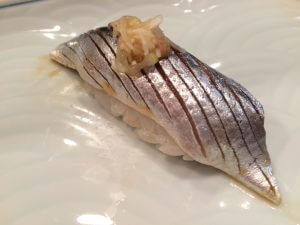 Ginger is used for toppings with a strong, distinct taste and strong fishy smell such as bonito, horse mackerel and sardines.
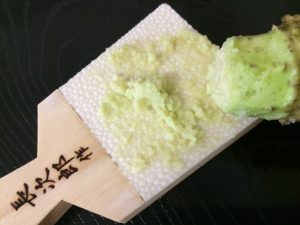 Wasabi has a spicy taste and stimulates the senses of taste and smell and works to dull the senses so the fishy smell is not felt, but ginger is effective in actually extinguishing the fishy smell.
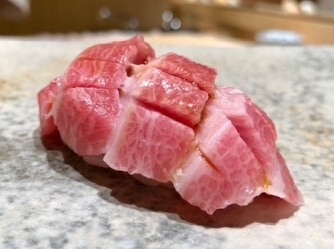 A single bite of the same bluefin tuna differs greatly depending on the part of the fish it came from.
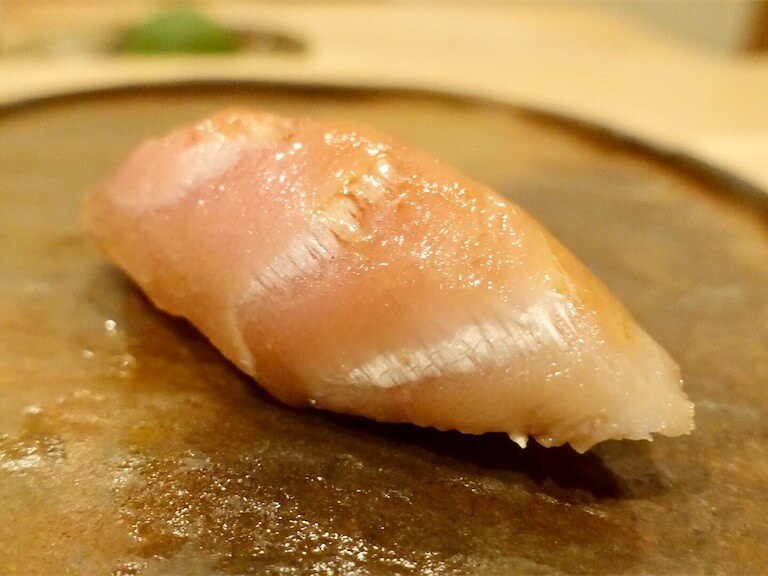 “
“ “
“ “
“ “
“
 A sushi chef, Hiroyuki Sato, serves a tossaki hand roll as the first sushi piece of the course. “
 The meat of tuna gets leaner and muscular striations are fewer towards the inner center of the body. “
 “
“ “Hireshita (ヒレ下)”
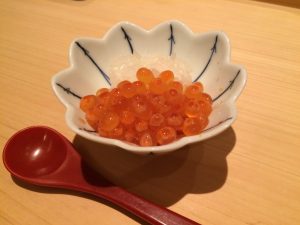 The natural salmon roe season is the autumn. Does this mean that most of the roe eaten during the off-season is artificial Salmon roe. Not necessarily. As stated in his biography, even at the famous sushi restaurant Sukiyabashi Jiro, frozen roe is thawed as necessary.
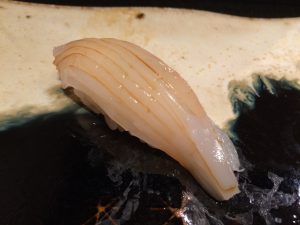 First of all, lightly applying just a small amount of Nikiri shoyu (sushi sauce) on the sushi topping, brings out its flavor and creates a glaze. To put it scientifically, this a clever use of the odor eliminating effects of soy sauce,
 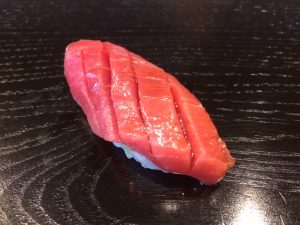 Also, long ago zuke (soaking in soy sauce) was also used for fish other than tuna. This was a way to utilize the
 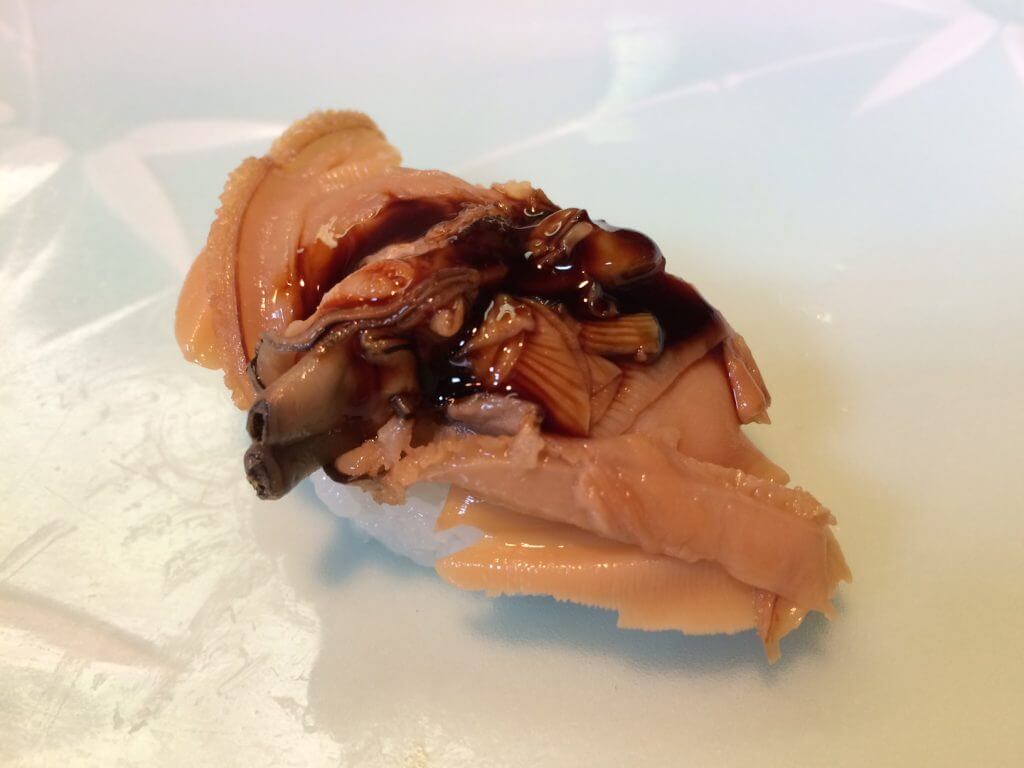 Tsume (sushi sauce) represents the thermal effects of soy sauce. By adding soy sauce, mirin and sugar then boiling down, the amino acids in the soy sauce and the sugar react and the goal is to create a
 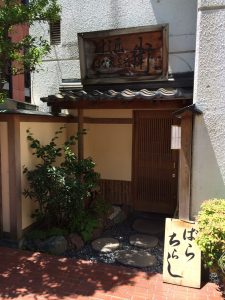 Sushi Sho (in Yotsuya) is a restaurant where you cannot make a reservation easily. Its founder,
  Kozasazushi (in Shimokitazawa) was opened by the legendary sushi chef, Shuzo Okada (passed away in May 2004). His successor, Tsutomu Nishikawa was, of course, his apprentice. The Omakase course is not an option at this restaurant. The only way to order is to look at the topping board and choose for yourself. This is a shop for experts and may be difficult for guests who can’t read or speak Japanese.
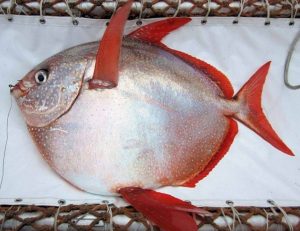 First of all, Opah belly meat with some fat is used for the tuna in Negi-toro (tuna minced with Welsh onion leaves). Opah is widely distributed in warm seas and it’s known to be inexpensive with a smooth taste. The price is less than 1/100 of the Pacific bluefin tuna and if possible Negi-toro made from Opah should be avoided.
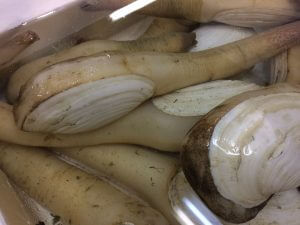 A premium sushi topping is the Mirugai clam (also called Hon-miru). This shellfish is characterized by its unique texture and taste. Instead the Japanese geoduck (Shiro-miru) is used, which sells for half the market price. However, the taste of the two is so similar that even Sushi Tsu has mistaken them, which is great news for dishonest dealers.
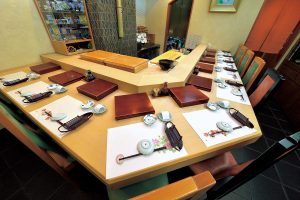 Hier lernen Sie alle Benimmregeln, die nicht nur in Sushi-Lokalen, sondern in allen Gaststätten Japans gelten. Das Wichtigste ist wohl, auf andere Rücksicht zu nehmen sodass sich andere Gäste im Lokal nicht gestört fühlen. Rücksichtnahme – das ist wohl das Wesentliche im japanischen Leben. Bitte merken Sie sich die hier aufgeführten Punkte.
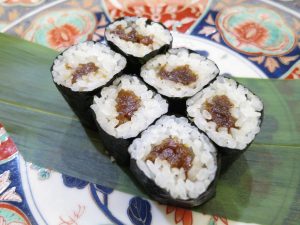 To maximize each flavor of toppings, have some pickled ginger or hot tea between different types of sushi for cleansing your palate. You don’t really have to stick to the specific order, though. It seems like having customers eat freely is the idea held in common by most sushi chefs. However, it is true that you won’t be able to taste the next flavor after eating something rather sweet. Japanese conger (Anago), Egg (Tamagoyaki), and Kanpyoumaki should be eaten at the end.