Large fish that are caught are always kept and transported on their side with their heads facing left from the port to the market and to the restaurant where they are served. The part of the fish facing down when in this position is called “Shitami” or the “bottom body” and the part facing up is called “Uwami” or the top body. The Uwami costs more than Shitami. This is because the Shitami takes on the weight of the Uwami, reducing the freshness and possibly causing cracks in the body (cracking occurs on the edges of the muscles).
This mostly applies to Pacific bluefin tuna (tuna that is consumed without any freezing after being caught). At any rate, since this fish costs hundreds of dollars per kilogram, a full-grown fish may be worth more than a luxury sports car. Therefore, from the time they make their catch, the fishermen work quickly, which affects all aspects of the quality. Most of all, this work affects the price. A Pacific bluefin is never placed directly on the deck of the ship. If a fish weighing 100 kg or more is set directly on the hard deck, its own weight would cause injury to its surface. Naturally, any damage or injury to the fish reduces the price. Instead, each fish is laid on a soft, spongy mat to protect its skin surface. Next, the blood is drained, the spinal cord nerves are destroyed and the fish is submerged in ice water. It might be easier to understand if you imagine handling a luxury vehicle, like a Ferrari, rather than a tuna fish.
We hope this information will be helpful.

Revision date: December 3, 2020
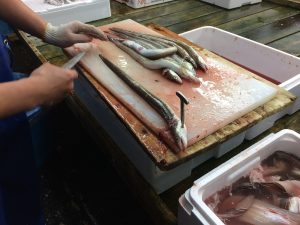 Many overseas visitors who aren’t used to eating fish have an aversion to
 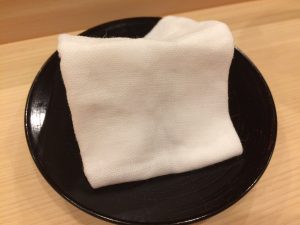 Sushi was originally a food eaten with your hands. Even, for example, if you are in a prestigious sushi restaurant in Ginza, you can still eat with your hands. You can actually use your hands to eat the ginger too. Restaurants that prefer you to eat with your hands will provide an extra,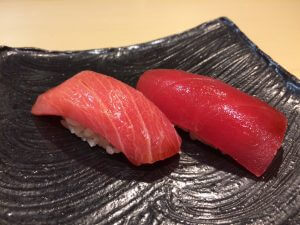
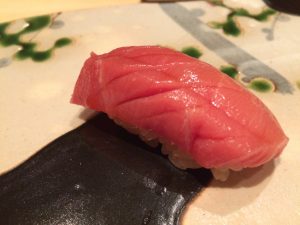
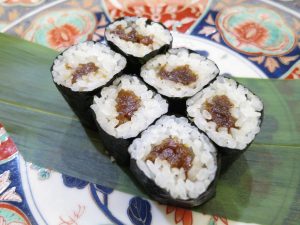 To maximize each flavor of toppings, have some pickled ginger or hot tea between different types of sushi for cleansing your palate. You don’t really have to stick to the specific order, though. It seems like having customers eat freely is the idea held in common by most sushi chefs. However, it is true that you won’t be able to taste the next flavor after eating something rather sweet. Japanese conger (Anago), Egg (Tamagoyaki), and Kanpyoumaki should be eaten at the end.
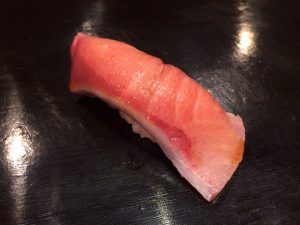
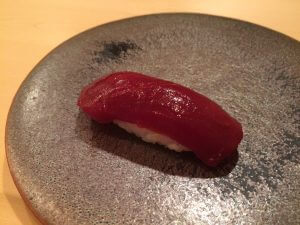 Zuke is one of the traditional Edo-style sushi methods. It is said that it was started in the Edo period to stop tuna from rotting when there were large amounts of the fish in the market. Now that there has been advances in refrigeration technology, it’s no longer necessary, but maturing the fish gives it a completely different taste and brings out its umami. Zuke is divided into two broad methods. Here we describe the characteristics of each.
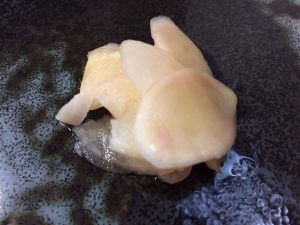 Gari is pickled ginger.
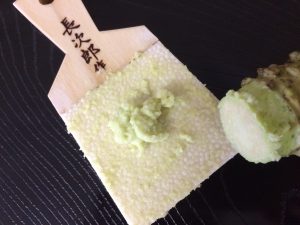 On the other hand, wasabi works by numbing senses of taste and smell with a stimulating spice so that the consumer doesn’t experience the fishy smell.
 Even if you order beer or sake at sushi restaurants, your meal will always end with a cup of tea. But if you’re going to go out for sushi, you should really start drinking that tea earlier instead of saving it until the end. The tea at sushi shops is far more significant than a simple beverage. Especially when eating fatty tuna or bonito, tea plays a role that beer and sake simply cannot fulfill.
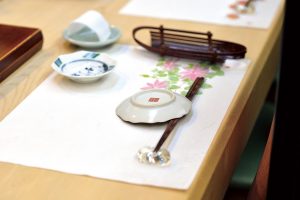 The sushi restaurant is unusual in that the customer sitting at the counter can see the seafood (neta) from which individual servings will be made, and can watch the chef deftly perform his art while enjoying lively conversation. Sushi restaurants also differ from other restaurants when it comes to menus.
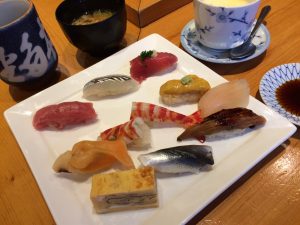 If the customer is inclined to worry about what the bill will come to, he orders
 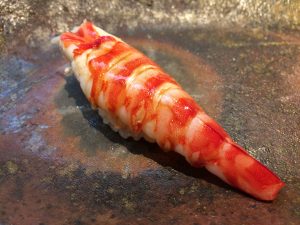 People at the counter most often order