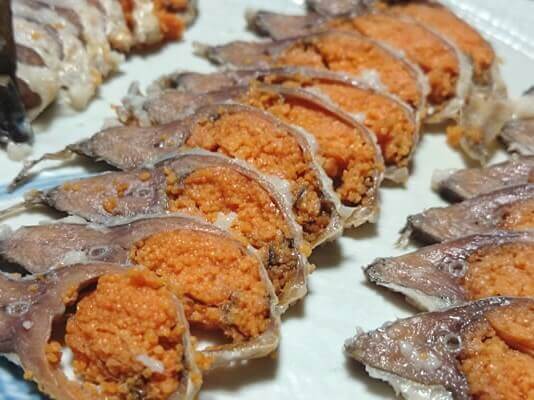
 Narezushi (mainly a preserved food in which fish undergoes lactic fermentation with salt and rice), in which Sushi finds its roots, can still be found even today throughout Japan. The most famous is Funazushi in Shiga prefecture.
Although it has “sushi” in the name, according to common knowledge of the day, it would be called crucian carp. The sweet and sour smell tickles your nose and it’s almost like pickled crucian carp. When you actually put it in your mouth it fills with an intense sourness and it can only be described as a really sour pickled food. However, the more you eat it, the more you somehow get used to it and in the end it becomes a favorite food that you will even crave. This effect is so mysterious that people even wonder, “Could this have been synchronized at some point with the tastes of our Japanese ancestors?”
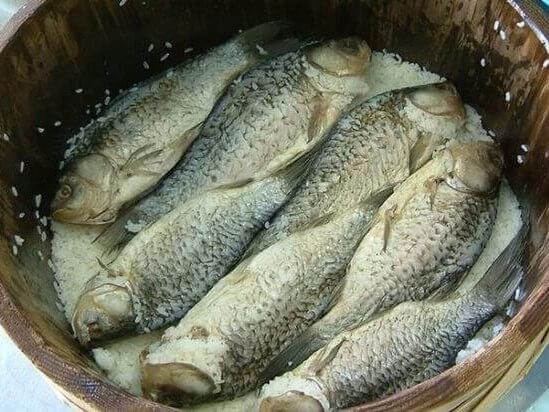 Making Funazushi sushi is surprisingly simple. The only ingredients are crucian carp caught in Lake Biwa, rice and salt. First the internal organs are removed from the crucian carp, next it is salted and then it is shade-dried. This crucian carp is packed tightly into freshly steamed rice in a large cask. “Sushizume” refers to this precise situation, and the ingredients are packed in so there is no air inside. If air is let in, the oxygen will cause microbiota to grow. In other words, it will rot. This is the most important thing in making funazushi.
While this cask is left for eight months to two years, special microorganisms will cultivate even without oxygen. These are lactic bacteria and acetic bacteria, which work to change the entire contents into a sour flavor.
After that, the mushy rice is removed from the finished Funazushi, and only the crucian carp is consumed. However, let me reiterate, this sour flavor is intense and complicated. Comparing it to bleu cheese or camembert cheese might make it easier to understand. The taste is so intense that it makes some people sick.
Incidentally, there are records from when Hideyoshi Toyotomi advanced his army to the Korean peninsula (around 1592), that Funazushi from Oumi was presented to soldiers on the front line as a comfort food. This episode illustrates the fact that Funazushi was a dish of pride for the people of the town of Nagahama (where Toyotomi’s castle was located, now part of Shiga prefecture).
We hope this information will be helpful.

Revision date: July 26, 2021
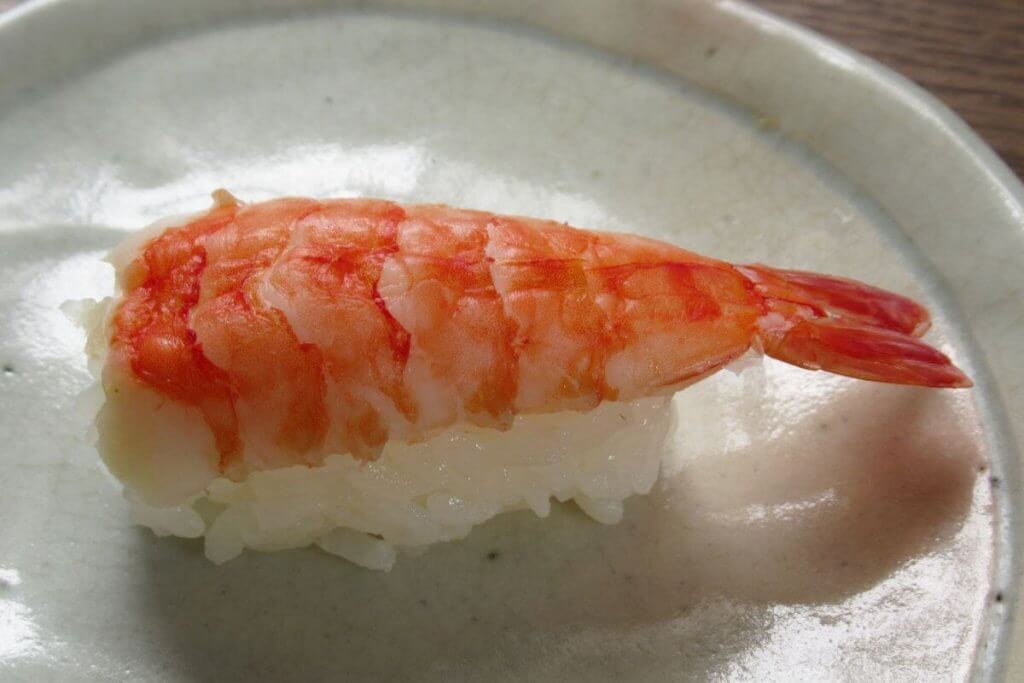 Black Tiger is in the category of the largest shrimp that is part of the Kuruma Ebi family and grows to be up to 30 cm. Black Tiger gets its name from the fact that it looks black before it is heated and has stripes like a tiger. The official name in Japan is “Ushi Ebi” but the reason is unknown. The Black Tiger is cultivated heavily in places like China, Vietnam, Indonesia, Thailand and India. It started to be imported from Taiwan in the 1980s to compensate when Japan’s shrimp consumption could no longer be covered by Kuruma Ebi. At the peak, it accounted for 40% of Japan’s shrimp imports. There is a strong impression of shrimp being imported, but small Black Tiger can actually be caught in Japan from Tokyo Bay southward.
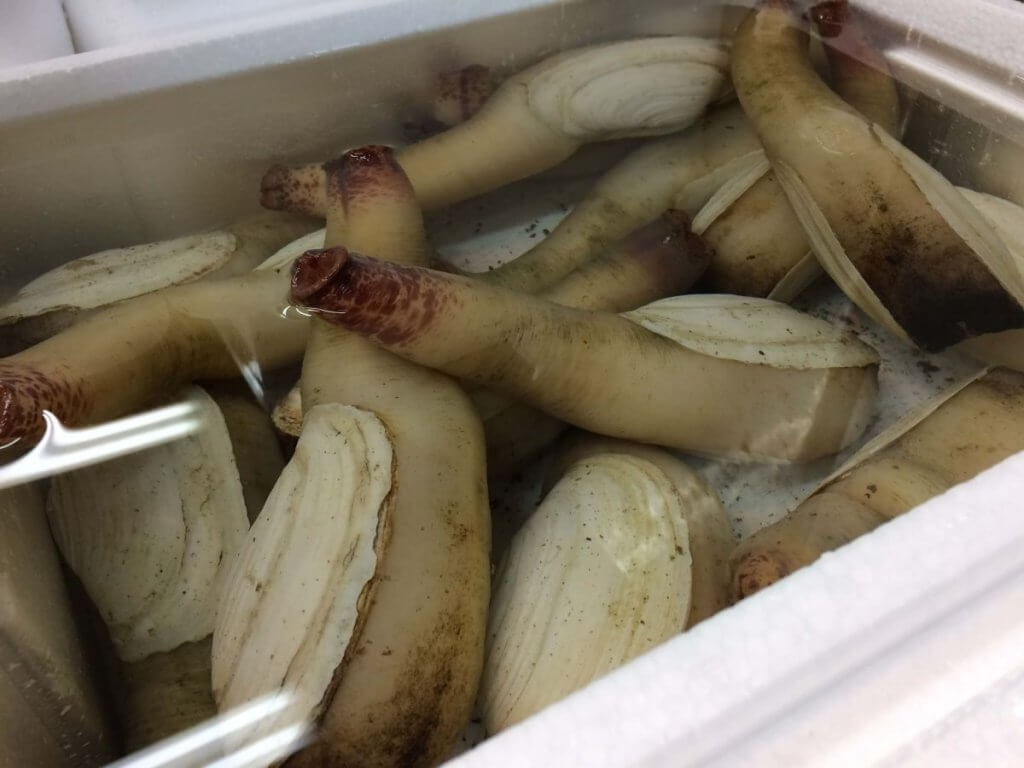 The official name of Mirugai is “Mirukui”. The part of the Mirugai that is used as a sushi topping is the siphon that bulges out from the shell. The siphon is separated from the shell and then this is cut through longways, from top to bottom. One Mirugai can only produce four pieces of sushi. It is also nearly extinct from overfishing. While it can still be caught in the Seto Inland Sea and Mikawa Bay, there are fishing limits, which means it is an ultra-high-priced sushi topping.